-
11/09/2026
What Is an Emergency Restoration System? A Guide for Transmission Utilities
When a permanent transmission tower comes down on a critical corridor, the corridor stays out. Either the permanent structure is rebuilt, or a temporary line goes up in its place. A permanent rebuild takes weeks. A temporary line built on an Emergency Restoration System (ERS) tower takes days.
This guide explains what an emergency restoration system is, how it works, which international standards define it, and where it fits inside a transmission utility’s grid-resilience plan. It is written for T&D planners, substation engineers, EPC teams and utility procurement heads who are evaluating ERS as a category.
On this page
- What is an emergency restoration system?
- Why do transmission utilities keep an emergency transmission restoration option ready?
- How does a transmission restoration system actually work?
- What voltage range and terrain does a temporary power restoration system cover?
- Which international standards should a utility check before selecting an ERS?
- When does a utility rent an ERS versus own a fleet?
- What does a real ERS deployment look like end to end?
- Where does an ERS fit in a utility’s grid-resilience plan?
- FAQs
What is an emergency restoration system?
Why do transmission utilities keep an emergency transmission restoration option ready?
Restoration speed is now a financial number, not only an engineering one.
The International Energy Agency has said that global grid investment must rise from USD 390 billion in 2024 to about USD 600 billion per year by 2030. It has called grids the potential “weak link” in the clean-energy transition.
At the same time, extreme weather is bringing down transmission structures more often. Cyclones on the east coast, flash floods in Himachal and hill-slope slippage in the northeast are all on the risk register today. DISCOMs, PGCIL and state transmission utilities carry the same exposure.
A permanent tower rebuild involves civil works, foundation curing, structural steel fabrication and re-stringing. That is weeks of unserved-energy liability, regulator scrutiny, and industrial-customer compensation exposure. A temporary line on an ERS tower closes that window fast. That is why an ERS option now sits inside the utility business-continuity plan.
How does a transmission restoration system actually work?
The mechanism is simple and the value is in the assembly speed.
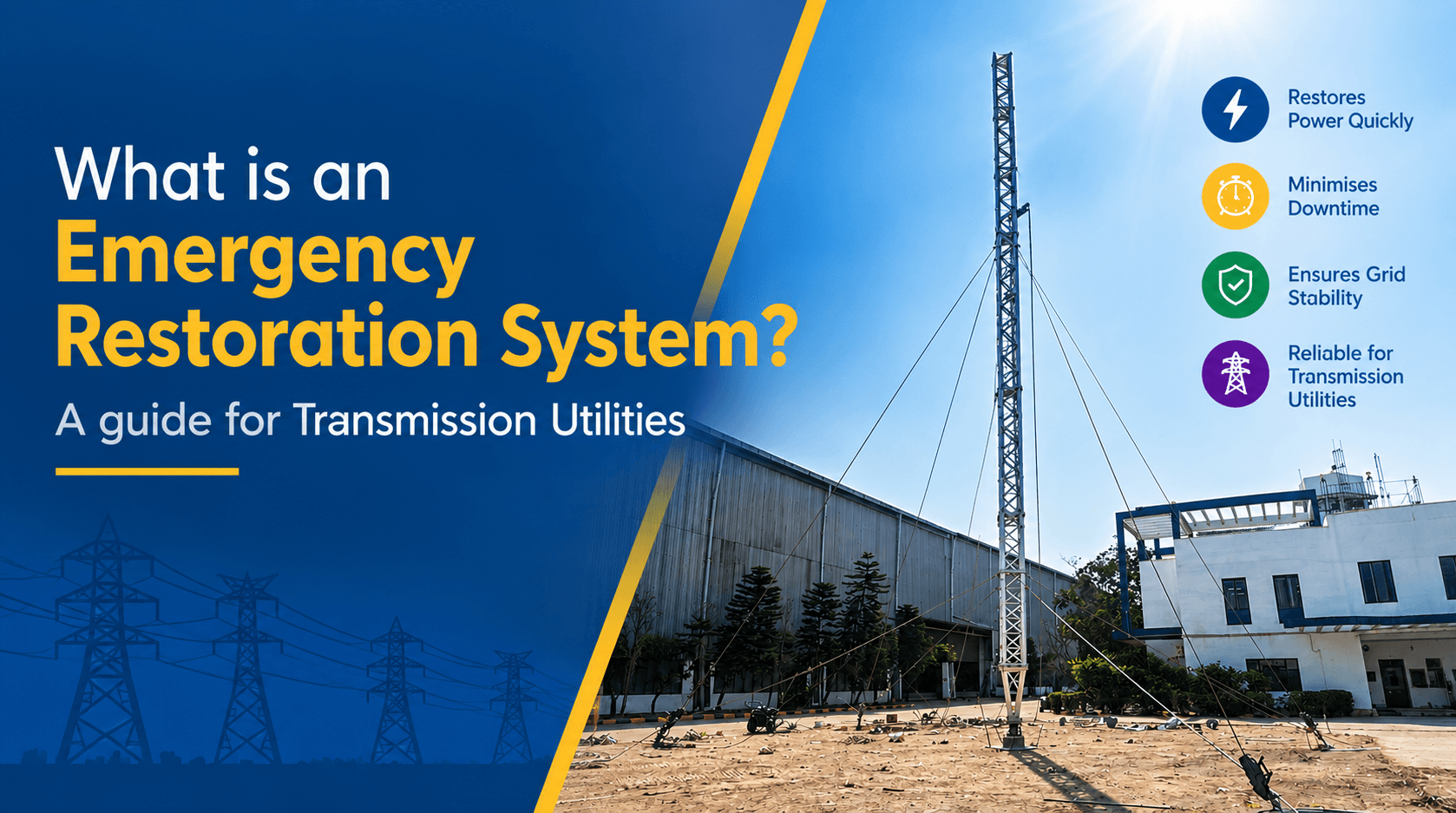
An ERS is a lattice or modular-frame structure supplied in short sections that can be carried by hand. A small crew assembles the sections on the ground and stands the tower up using a Gin Pole or similar method. Guy wires anchor it, and the temporary conductor is strung across. No cranes. No concrete. No civil delay.
Our own ERS towers ship in 20ft containers and need only a 4-to-6-person crew. They are built from aluminium alloy for lower weight and reuse. Every supply project carries PLS Pole- PLS CADD modelling.
Two structural designs dominate the market. Lattice-type ERS uses a bolted lattice pattern similar in appearance to a scaled-down permanent tower. Modular-type ERS uses standardised frame sections stacked to the target height. Both support the standard line configurations a utility already runs: dead-end/tension, suspension, running angle, herringbone and chain.
What voltage range and terrain does a temporary power restoration system cover?
A modern ERS is not a single-voltage tool. It is a family of configurations across the transmission voltage band.
Our ERS towers cover 33 kV to 800 kV, across single and multi-circuit configurations. That range takes the same product family from a sub-transmission urban feeder to an EHV interstate corridor. The site conditions the tower can handle matter just as much as the kV number.
On the ground, an ERS should install cleanly on level terrain and on slopes up to about 30 degrees. It should also work on soft soil, rock, marshy ground and mid-river locations.
Anchor selection is what makes that possible. Helical, cross-plate, Manta Ray and rock anchors each handle a different soil profile. Specifying an ERS is partly a soil-mechanics question, not only a structural one. That is one of the reasons PLS Pole-PLS CADD modelling is done span-by-span for every deployment.
Which international standards should a utility check before selecting an ERS?
Two references matter, and one is more definitive than the other.
IEEE 1070 is the international standard specifically for modular emergency restoration structures used on transmission systems. It defines design, testing and installation requirements for temporary towers used to restore or bypass a damaged line. A utility checking an ERS supplier should ask for evidence of compliance, not only for a mention of the number.
IEC 60652 covers loading tests on overhead-line support structures. It is a broader load-testing framework, applicable to lattice steel towers in general, and useful when a utility wants third-party verification of load-carrying capacity.
Two supporting checks are worth adding to any procurement questionnaire. First, a technology-partner association with a recognised research body. We work with CSIR-SERC on the design side, which brings independent verification into the loop. Second, project level PLS Pole-PLS CADD modelling. Off-the-shelf models are not enough. Each corridor needs a span-specific model that accounts for terrain, conductor tension and wind zone.
When does a utility rent an ERS versus own a fleet?
Both models are valid. The choice depends on how the utility values capex, response time and geographical exposure.
Renting an ERS works well when a utility wants zero upfront investment and does not have the storage or trained crew for a permanent stock. It also gives the utility a fully managed response covering survey, design, erection and 24/7 monitoring. Rental turns emergency restoration into an operating expense that the utility calls on when needed. See ERS Rental on htser.in for how our rental scope is packaged.
Owning an ERS fleet works well when a utility has multiple risk corridors and needs guaranteed availability during a wide-area event such as a cyclone. It works when the utility can absorb the training and storage cost. Ownership also gives control over restoration KPIs and internal drill readiness. See ERS Supply for supply scope, training and long-term support.
Some utilities run a hybrid. A small owned fleet covers the top-risk corridors for baseline readiness, with rental capacity called in when a wide-area event overwhelms the owned stock. The right split is a function of load-at-risk, regulator penalty exposure and past outage frequency on that network.
What does a real ERS deployment look like end to end?
A well-run ERS deployment moves in six steps. Each step has an owner, a duration, and a checkpoint.
- Site survey. GPS location, terrain, soil, span data and access. Same day for a nearby corridor; 24 hours where reachability is difficult.
- PLS Pole-PLS CADD modelling. Span-specific design for the exact tower height, line configuration and wind zone. Turnaround measured in hours, not days.
- Mobilisation. Sections and hardware ship from the nearest depot. Because sections travel in 20-ft containers, road access to the site is the only real constraint.
- Foundation and anchoring. Base plates and anchors are set. No civil curing, so this step is measured in hours.
- Tower assembly and erection. A 4-to-6-person crew assembles and stands the tower using a Gin Pole method. No crane is required.
- Stringing and re-energisation. Conductor is strung across the ERS bypass and the line is re-energised, with the permanent rebuild continuing in parallel.
For tower collapse recovery, this end-to-end cycle is the difference between a multi-week outage and a multi-day one. For planned maintenance and reconductoring, the same cycle avoids the large planned outage window that would otherwise be needed.
Where does an ERS fit in a utility’s grid-resilience plan?
An ERS is a restoration layer. It is not a substitute for permanent-line investment, redundancy planning or vegetation management. It sits underneath the grid-hardening plan as the mechanism that shortens the tail of a failure event.
A well-designed grid-resilience plan pairs three layers. Preventive investment reduces the frequency of failures. Redundancy planning reduces the impact of a single failure. An ERS layer reduces the duration of the failures that still happen. The three together are what a utility board can point to when a regulator asks how a utility is managing grid failure business risk.
For utilities running large infrastructure corridors, ERS also has a project-side role, not only an emergency one. Highways, railways and industrial parks that need transmission diversion for civil work benefit from the same equipment. See infrastructure projects on htser.in for scope covered under that use case.
Frequently asked, questions
Yes, grid failure is a business risk or an engineering risk. The engineering causes have not changed. The financial consequences have grown large enough and regulator scrutiny has become close enough that utility boards need grid failure sitting inside enterprise risk, not only inside the control room.
Two drivers together. First, reserve margins are compressing as older plants retire faster than new grid capacity is added. Second, extreme weather events are raising the frequency and severity of restoration cycles. Ageing transmission assets amplify both.
An ERS tower certified to IEEE 1070 lets a utility bypass a fallen permanent tower and reenergise the corridor while the permanent rebuild proceeds. Restoration time collapses from weeks to days, cutting unserved energy liability and regulator exposure.
Energy Storage as a Service (ESaaS) is a subscription model that puts battery capacity on the grid without utility capex and its market is growing fast. Kaiso Research’s flag for boards: dispatch authority during grid emergencies is still not clearly defined in ESaaS contracts, which is itself a risk for the board.
Talk to Our Engineer
If you are evaluating an ERS category decision, we can walk you through the standard checks and the terrain profile of your risk corridors. We will also work through the rent-versus-supply trade-off for your load-at-risk.