
-
11/09/2026
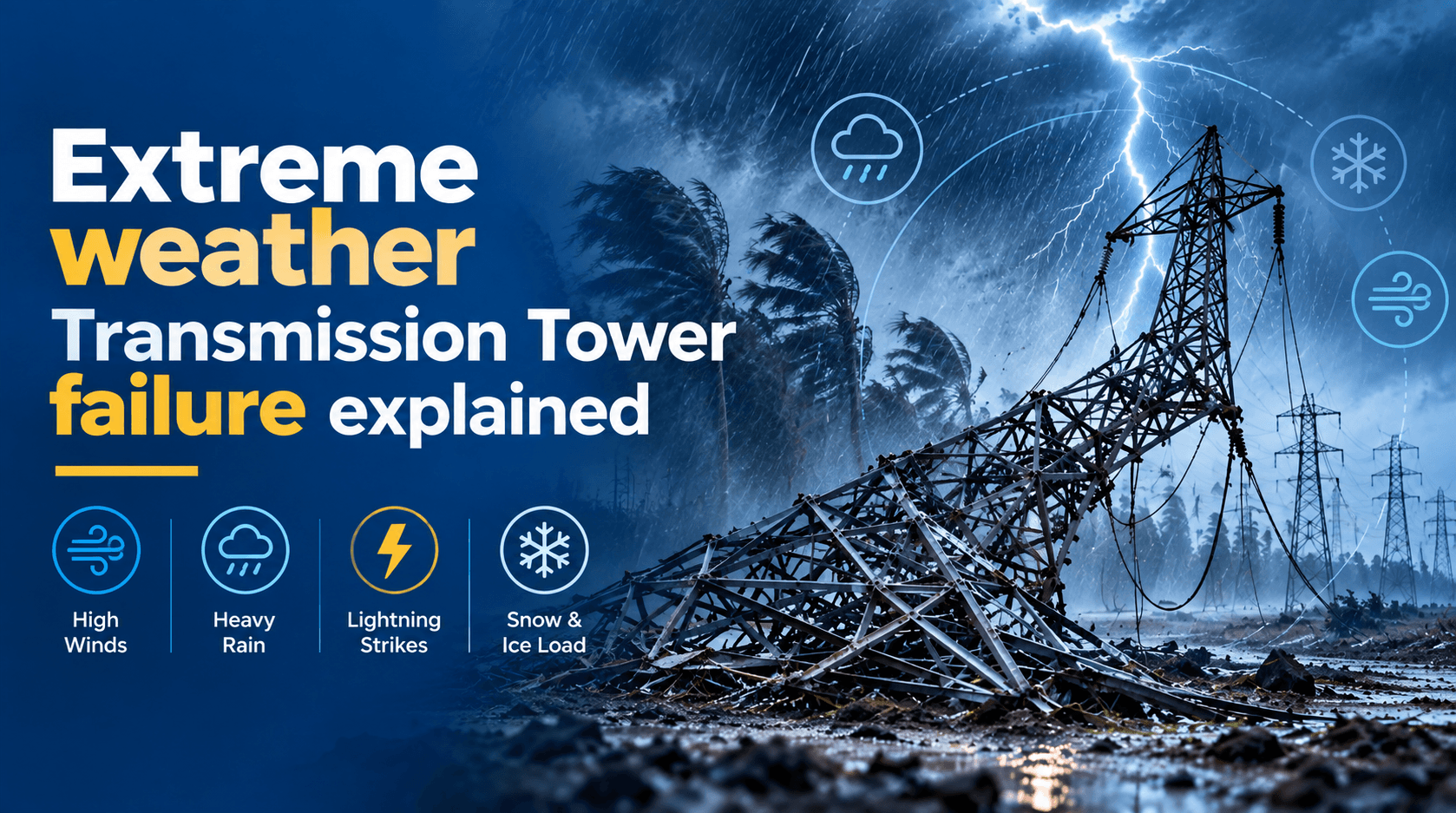
Extreme weather Transmission Tower failure explained
A collapsed tower is not a maintenance problem. It is a penalty problem, a revenue problem and a public-pressure problem, all running on the same clock.
Between December 2015 and September 2016, 38 transmission towers across 18 EHV lines failed in India and were reported to the Central Electricity Authority. That figure comes from the CEA’s own Standing Committee of Experts, and it counts only the failures that utilities chose to report.
This article looks at why extreme weather brings towers down, and why getting the line back is harder than the collapse itself. If you are evaluating standby capacity rather than reading up on the mechanics, start at ERS Rental instead.
On this page
- What counts as extreme weather transmission tower failure?
- How often do transmission towers fail in India?
- Which weather events cause the most transmission line damage?
- Why does cyclone transmission tower damage rarely stop at one tower?
- How is flood transmission tower failure different from wind failure?
- Why is restoring a failed tower harder than building one?
- What does grid weather resilience look like before the season?
- Frequently Asked Questions
What counts as extreme weather transmission tower failure?
Extreme weather transmission tower failure is the collapse or loss of service of a transmission tower under wind, cyclone, storm, ice or flood loading beyond its design capacity. It covers buckled legs and diagonals, sheared stubs, uprooted foundation chimneys and scoured footings. The line goes out either because the tower comes down, or because the conductor can no longer hold its position.
The CEA groups Indian EHV failures into six recognisable patterns:
- Stub-level buckling: the tower folds from the stub upward, usually a total collapse
- First-panel buckling: failure just above the first panel, foundation sometimes intact
- Cross-arm or peak failure: upper structure fails while the lower body stands
- Chimney uprooting: the foundation itself lifts out
- Scour damage: soil erosion removes support beneath the footing
- Stub shearing: torsional forces shear leg stubs when one leg sinks.
Those patterns matter for restoration planning. A tower that failed at the cross-arm is a different recovery job from one whose foundation has washed into a river.
How often do transmission towers fail in India?
Reported EHV tower failures in India run in the dozens per year. In the CEA’s December 2015 to September 2016 review period, 38 towers failed across 18 lines: 14 towers on six 765 kV lines, 18 towers on nine 400 kV lines and six towers on three 220 kV lines. Suspension towers accounted for 23 of the 38, or roughly 60%.
The reported number understates the real one. The CEA notes plainly that many state and private transmission licensees neither report tower failures nor attend the national review, so the committee works from partial data.
Two further findings in the same report are worth holding onto. Structural testing at CPRI showed an average 23% tower failure rate during type testing over the preceding five years, with higher rates at higher voltages. And the BIS wind map had not been revised at the time of the report, despite CSIR-SERC submitting an updated version.
Which weather events cause the most transmission line damage?
Wind is the dominant cause worldwide. A 2025 review in Applied Sciences examined more than 100 major outage events between 2005 and 2023. It attributed about 40% to hurricanes and typhoons, 35% to snow and ice storms and 15% to heavy rainfall and flooding.
India’s mix skews towards wind, water and heat rather than ice. A 2024 study of 300 Indian localities measured the effect. Heatwaves lengthened outage durations by 15% to 60%, heavy rainfall by 80% to 220% and wind gusts by 20% to 70%.
Ice still matters on northern and high altitude lines. Field data from Inner Mongolia found faults roughly doubled during heavy snow and ice. Wind above 80 km/h and ice loads above 25 mm correlated most strongly with trips.
Why does cyclone transmission tower damage rarely stop at one tower?
Because a transmission line is a coupled system, not a row of independent structures. When one tower fails, the conductor tension it was holding transfers longitudinally into the next towers in the run, and the failure walks down the line. Cyclone transmission tower damage is therefore usually measured in spans, not in single towers.
Typhoon Mujigae shows the scale. It made landfall at Zhanjiang in Guangdong in October 2015 with near-centre winds of 50 m/s. In that single event 206 transmission lines above 35 kV failed, and 80 of those suffered tower collapse.
The same study modelled one 220 kV river-crossing suspension tower from that event, carrying spans of 490 m and 440 m. Its ultimate wind capacity came out at 34.8 m/s under static nonlinear buckling analysis and 34 m/s under a dynamic tower-line coupled model. Mujigae exceeded both by a wide margin.
One detail from that paper changes how these towers should be assessed. Static analysis predicted the leg members would buckle first; dynamic analysis showed the diagonals going first. Same tower, same capacity, different failure location, which means an inspection team looking only at legs can miss the member that actually gave way.
How is flood transmission tower failure different from wind failure?
Flood transmission tower failure attacks the foundation rather than the steel. Wind overloads members above ground; water removes the ground itself. The CEA lists three flood causes separately from high wind: river-bank scour from flash floods, landslide-driven soil erosion on hill slopes, and stub shearing from differential leg settlement.
The recovery problem is different too. A wind failed tower on firm ground can often be rebuilt on the existing foundation. A scoured foundation means new soil investigation, possibly pile foundations, and a site that may still be under water.
The CEA’s own recommendation for flood-prone locations is pile-type foundations, selected against fresh soil investigation and current high-flood data.
Substations compound it. When Chennai flooded in 2015, waterside substations were submerged and supply was cut for a week, and the 2022 Bengaluru floods damaged transformers and flooded stations.
Why is restoring a failed tower harder than building one?
Because everything that makes a permanent tower strong also makes it slow. A rebuild needs soil investigation, concrete foundations, curing time, crane access and a road capable of carrying that crane. That adds up to four to eight weeks.
During monsoon or post-cyclone conditions, the access road is often the first thing to disappear.
This is the gap an Emergency Restoration System is designed to close. ERS towers are modular aluminium alloy structures that bypass the damaged tower and carry the line at its original voltage while the permanent rebuild proceeds behind them. They need no concrete foundation, no cranes and no civil work, and a 4 to 6 person crew can raise one with hand tools.
We have been executing ERS projects for 12+ years and running rental operations for eight, across 33 kV to 800 kV. The towers are designed to IEEE 1070:2006 and load-rated to IEC 60652, with testing at NABL-accredited labs. Every supply project is modelled in PLS-CADD, and CSIR-SERC is our technology partner on structural work.
Proof point
Our current Powergrid programme covers 150 nos. 400 kV and 25 nos. 765 kV ERS towers, the largest ERS production programme in the country. It is built at 1 lakh sq. ft. ERS facility running two robotic aluminium welding machines, and supported by 50+ trained ERS field personnel and 14 offices across India. ”
Two designs cover most failure scenarios. Lattice Type handles high-load 400 kV to 765 kV runs and long spans; Modular Type assembles fastest and suits disaster response. Both ship in 20-ft containers.
Anchors are Helical, Manta Ray, Cross Plate or Rock, chosen for ground conditions. That is what keeps a scoured river-bank site workable.
What does grid weather resilience look like before the season?
Grid weather resilience is decided in procurement, not in the storm. The towers that fail are disproportionately the ones designed to older codes, and the recovery that goes fast is the one where standby capacity was already contracted.
Three points from the CEA record translate straight into procurement decisions:
- Design vintage matters: IS:802 (Part 1) has been revised in 1973, 1977, 1995 and 2015, and India’s three wind zones were expanded to six. Lines still running on IS:802-1977 designs carry different margins from new construction. The CEA notes the 2015 revision optimised design in ways that “might have changed” the margin.
- Theft weakens towers before weather finishes them: the CEA lists theft of secondary members as a named failure cause, and recommends increased patrolling in theft-prone areas with prompt member replacement.
- Repeat failures need retrofit, not repair: for lines failing repeatedly on IS:802-1977 designs, the committee recommends hip bracing up to bottom cross-arm level, alongside GFRP and steel-clip strengthening of live members.
Add contingency stock to that list. Pre-positioned ERS inventory converts a four to eight week rebuild into a restoration measured in hours. It is the one part of the plan that has to exist before the cyclone, not after.
For utilities buying rather than renting that capacity, ERS Supply covers the procurement route, and ERS Installation covers crew mobilisation.
The takeaway: towers fail at their weakest design assumption, and lines come back at the speed of whatever was already on the shelf.
Frequently asked, questions
Published analysis of one collapsed 220 kV suspension tower put its ultimate wind capacity at 34 to 34.8 m/s. The figure depends on the design code the tower was built to. Typhoon Mujigae reached near-centre winds of 50 m/s at landfall. Indian towers are designed against IS:802 wind zones, expanded from three zones to six.
Dynamic analysis of a collapsed 220 kV tower found the diagonal members buckled first, while static analysis of the same tower predicted leg buckling. That difference matters for post-storm inspection, because a team checking only leg members can miss the element that actually initiated the collapse.
A permanent tower rebuild takes four to eight weeks because of foundation work, curing and crane access. An Emergency Restoration System bypasses the damaged tower instead. A 4 to 6 person crew can raise one within hours using hand tools, against a 72-hour deployment benchmark from mobilisation.
Yes. ERS towers need no concrete foundation, and anchor with Helical, Manta Ray, Cross Plate or Rock anchors chosen for the ground condition. They can therefore stand on soil which would not yet support a permanent footing. That is often the deciding factor on scoured river-bank locations.
It depends on how often your network is exposed. Rental removes the capital burden and the storage obligation while keeping capacity contracted before the season; purchase suits utilities that want permanent standby stock on their own premises. We run both, and have operated a structured ERS rental programme for eight years.